
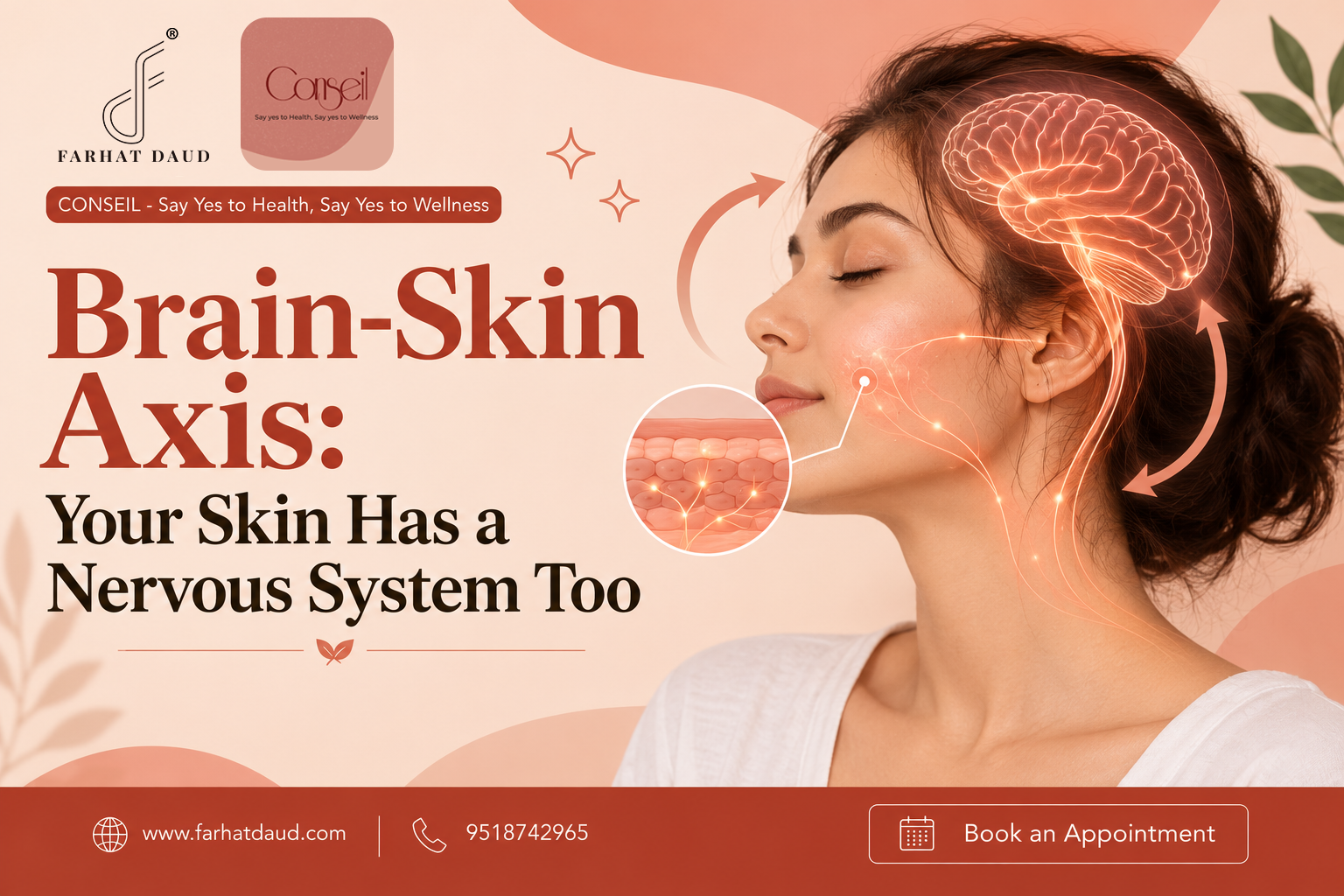
Your Skin Has a Nervous System Too. Here’s Why That Matters.
Ever noticed your skin acting up when life gets chaotic?
A breakout before an important event.
More sensitivity after a stressful week.
Dull, tired-looking skin after a few nights of terrible sleep.
Your skincare routine hasn’t necessarily stopped working.
Your skin may simply be responding to more than skincare.
Here’s where comes in, the brain-skin axis.
What is the brain-skin axis?
The brain-skin axis describes the two-way communication between your brain, nervous system, hormones, immune system and skin.
So the relationship isn’t simply:
“I’m stressed → I get a breakout.”
It’s much more interesting than that.
Your brain can influence what’s happening in your skin, while signals from the skin can also affect the nervous system and your overall wellbeing. Stress-related neuroendocrine and immune signalling can influence inflammation and skin-barrier function.
Think of your skin as a conversation, not a canvas.
And sometimes, it’s telling you that something is going on beyond the surface.
Stress doesn’t just live in your head
When you’re under psychological stress, your body activates systems designed to help you respond to that challenge.
One of them is the HPA axis, a stress-response system involving the brain, endocrine system and adrenal glands.
The resulting hormonal and neural signals can affect processes in the skin, including immune activity, inflammation and barrier function.
This is why some people notice their existing skin concerns becoming more noticeable during stressful periods.
But here’s the important part:
Stress isn’t automatically the cause of your acne, eczema, sensitivity or other skin concern.
Skin is complicated.
Genetics, hormones, environment, products, UV exposure, lifestyle and underlying conditions can all play a role.
Stress is one signal in a much bigger system.
Your 3 a.m. thoughts might show up at 7 a.m.
There’s another connection worth paying attention to:
Sleep.
Your skin follows circadian rhythms too. Research suggests that biological clocks influence processes including skin-barrier function, immune activity, blood flow, pigmentation and repair. Sleep disruption may also affect skin-barrier integrity and skin homeostasis.
So when your routine becomes:
3:00 a.m. overthinking
7:00 a.m. alarm
7:05 a.m. “Why does my skin look exhausted?”
…your skin may be feeling the schedule too.
No, one late night won’t destroy your skin.
But consistently poor sleep?
That’s a habit worth paying attention to.
And then there’s the skin barrier
If you’ve been hearing “skin barrier” everywhere lately, there’s a reason.
Your skin barrier helps keep moisture in and unwanted external irritants out.
Stress can influence barrier function, while disrupted barrier function can contribute to increased sensitivity and inflammation.
Which is why aggressively attacking stressed-out skin with:
new acid + new retinol + new exfoliator + new serum
…isn’t always the answer.
Sometimes your skin needs less experimentation and more recovery.
Your skincare routine is only half the story
Healthy skin isn’t built entirely at the bathroom mirror.
Think about the inside-out basics too:
Sleep well.
Give your body enough time to recover.
Manage stress.
Find ways to genuinely switch off whatever that looks like for you.
Nourish yourself.
A balanced diet supports overall health.
Move your body.
Regular physical activity supports physical and mental wellbeing.
Keep skincare gentle.
Especially when your skin is irritated or reactive.
And know when to get help.
Persistent or worsening skin concerns deserve proper professional evaluation.
The bigger picture: your skin is part of you.
We’re used to treating skincare as a very surface-level conversation:
What should I apply?
Which ingredient should I use?
What will make my skin glow?
But modern skin health asks a bigger question:
What is happening to the person behind the skin?
Your sleep.
Your stress.
Your environment.
Your hormones.
Your immune system.
Your daily habits.
Even the microorganisms living on your skin are part of an increasingly studied skin microbiome-barrier-immune network.
The science is still evolving, but one thing is becoming increasingly clear:
Skin health doesn’t exist in isolation.
So the next time your skin suddenly decides to have a moment, don’t immediately assume you need another product.
Pause.
Look at the bigger picture.
Because sometimes, your skin isn’t asking for more skincare.
It’s asking you to listen.
Conseil takeaway
Clearer skin isn’t always about adding more. Sometimes it’s about understanding more.
Say Yes to Health, Say Yes to Wellness!
